If you have ever held a precision-engineered part—whether it is a bracket from an aircraft, a titanium medical implant, or even the aluminum case of the smartphone in your pocket—you have held the result of CNC Machining. As a manufacturing engineer with years of experience on the shop floor, I have watched this technology transform the way we make things. It is the backbone of modern industry, and understanding it is essential for anyone involved in product design, engineering, or procurement.
In this comprehensive guide, we will cover everything you need to know about CNC machining: how it works, the different types of machines, the materials you can use, and why it remains the gold standard for precision manufacturing.
What Does “CNC” Mean?
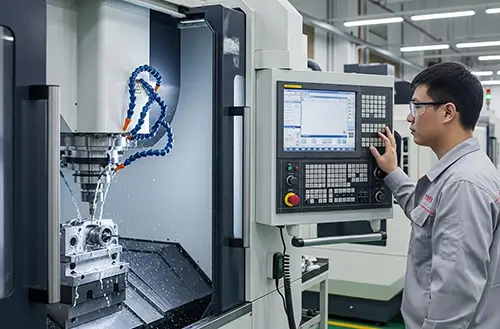
Let’s start with the acronym. CNC stands for Computer Numerical Control. In simple terms, it means using computers to control machine tools. Instead of a machinist turning handwheels to move a cutting tool, a computer program tells the machine exactly where to go, how fast to move, and when to cut.
Think of it like this: if manual machining is like driving a car with manual steering, CNC machining is like handing the wheel to a GPS-guided autopilot. The autopilot follows a pre-programmed route with microscopic precision, every single time.
The “program” that guides the machine is called G-code. This is a language of coordinates and commands that tells the machine:
- Where to move (X, Y, Z positions)
- How fast to move (feed rate)
- How fast to spin the tool (spindle speed)
- When to turn coolant on or off
- When to change tools
Once the program is written and tested, the machine can run the same part over and over, 24 hours a day, with consistent quality that human hands could never achieve.
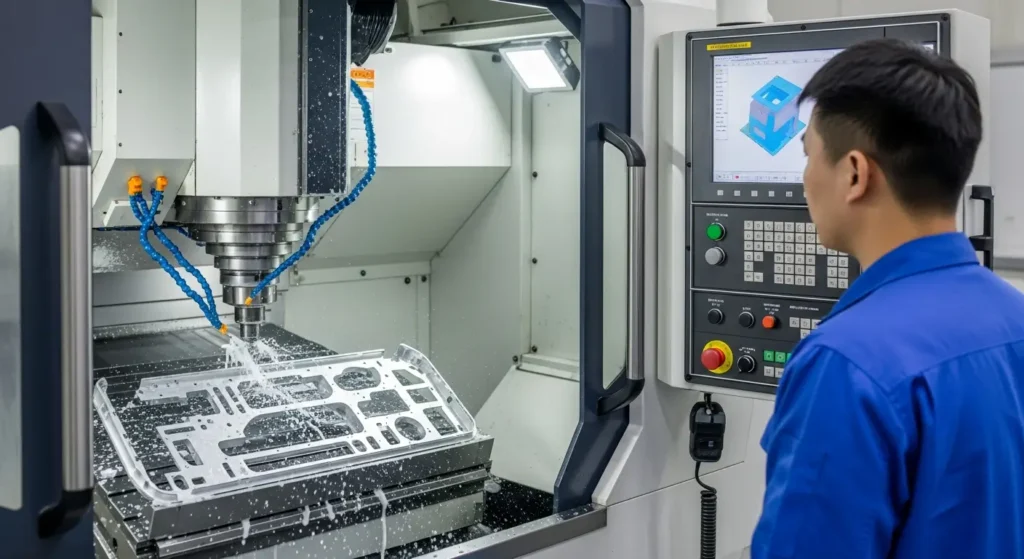
How CNC Machining Works: The Basic Process
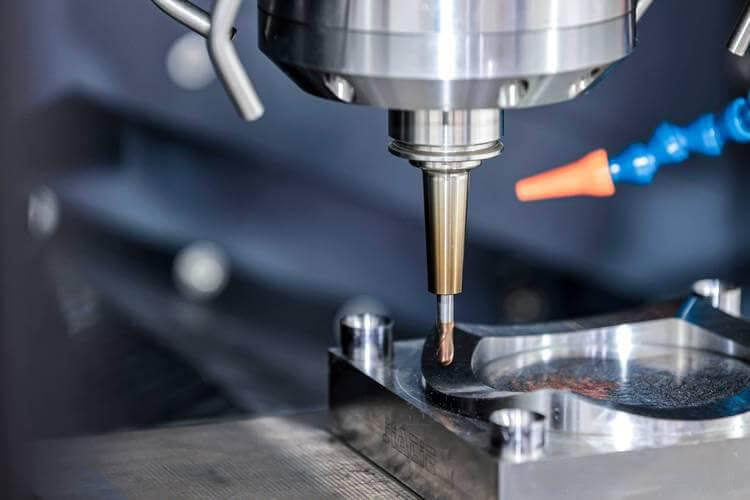
CNC machining is a subtractive manufacturing process. This means we start with a solid block of material (called the workpiece) and remove material to reveal the final shape. It is the opposite of 3D printing, which adds material layer by layer.
Here is the step-by-step process we follow at XINRICO for every job:
- Design: The engineer creates a 3D CAD (Computer-Aided Design) model of the part. This is the digital blueprint.
- Programming: CAM (Computer-Aided Manufacturing) software converts the CAD model into toolpaths—the specific routes the cutting tool will follow.
- Setup: The machinist mounts the raw material onto the machine, loads the required tools into the tool changer, and sets up work offsets.
- Machining: The machine runs the program, automatically changing tools as needed, until the part is complete.
- Inspection: The finished part is measured against the blueprint to verify it meets all tolerances.
- Finishing: Secondary operations like deburring, cleaning, or surface treatment are performed.
The Main Types of CNC Machining
CNC machining is an umbrella term that covers several distinct processes. The two most common are milling and turning, but there are others you should know.
| Process | How It Works | Typical Parts |
|---|---|---|
| CNC Milling | Rotating cutting tool removes material from a stationary workpiece. | Brackets, housings, enclosures, complex 3D shapes. |
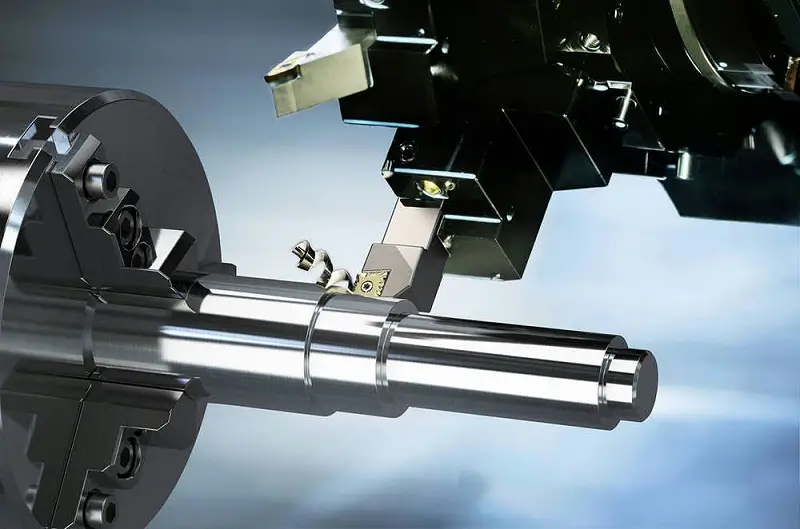
| CNC Turning | Workpiece rotates while a stationary cutting tool shapes it. | Shafts, bushings, rings, threaded components. |
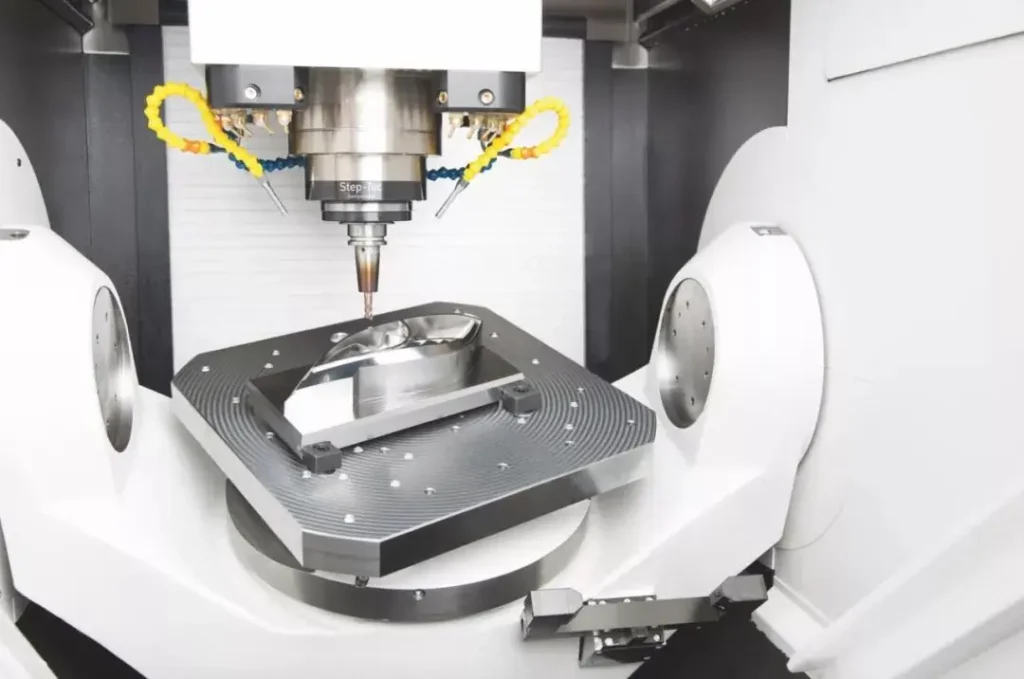
| 5‑Axis Machining | Advanced milling where the tool or workpiece tilts to reach complex angles. | Aerospace impellers, medical implants, turbine blades. |
| Swiss Machining | Specialized turning for small, long, and complex parts. The material moves through a guide bushing. | Watch components, dental screws, medical instrument parts. |
| EDM (Electrical Discharge Machining) | Uses electrical sparks to erode conductive materials. | Mold cavities, hardened tooling, intricate details. |
| Grinding | Uses an abrasive wheel to achieve extremely fine surface finishes and tight tolerances. | Precision shafts, bearings, cutting tools. |
At XINRICO, we specialize in milling, turning, and 5‑axis machining, but we partner with trusted shops for EDM and grinding when your project requires it.
CNC Machining Centers: Configurations Explained
When you walk onto a shop floor, you will see machines of all shapes and sizes. Here is how they break down:
By Spindle Orientation
| Type | Description | Best For |
|---|---|---|
| Vertical Machining Center (VMC) | Spindle is vertical; table moves in X and Y. | General machining, prototyping, tool rooms. |
| Horizontal Machining Center (HMC) | Spindle is horizontal; table rotates for access to multiple sides. | High-volume production, heavy cuts, automotive parts. |
| Multi-Tasking Machines | Combines milling and turning in one machine. | Complex parts requiring both operations. |
By Number of Axes
| Configuration | Axes | Capabilities |
|---|---|---|
| 3‑Axis | X, Y, Z | Basic machining from one direction. |
| 4‑Axis | X, Y, Z + A (rotary) | Machining on multiple faces in one setup. |
| 5‑Axis | X, Y, Z + A, B (or C) | Full contouring; tool approaches from any angle. |
| Multi-Axis Turning | X, Z, C, Y (with live tools) | Turning with milling, drilling, and tapping capabilities. |
The more axes you have, the more complex the parts you can produce—and the fewer setups you need to get there.
Common CNC Machining Operations
A CNC machine can perform a wide variety of operations, depending on the tools loaded in the spindle. Here are the most common:
- Facing: Creating a flat reference surface on the top or end of a part.
- Profile Milling: Cutting around the outline of a part.
- Pocketing: Removing material inside a closed boundary to create a recess.
- Drilling: Producing holes of various diameters.
- Tapping: Cutting internal threads in a drilled hole.
- Boring: Enlarging and finishing an existing hole to a precise diameter.
- Reaming: Finishing a hole to an exact size with a smooth surface.
- Grooving: Cutting narrow channels or recesses.
- Threading: Producing external or internal screw threads.
- Knurling: Creating a textured pattern on a surface for grip.
Modern CNC machines can perform all these operations automatically, changing tools as needed without operator intervention.
Materials We Machine
One of the greatest strengths of CNC machining is its material versatility. We can cut almost anything that is rigid enough to hold still.
| Material Category | Common Grades | Typical Applications |
|---|---|---|
| Aluminum | 6061, 7075, 2024, 5052 | Aerospace, automotive, consumer products. |
| Steel | 1018, 4140, A36, 12L14 | Machine parts, shafts, structural components. |
| Stainless Steel | 303, 304, 316, 17‑4 | Medical, food equipment, marine hardware. |
| Tool Steel | H13, D2, A2, O1 | Molds, dies, tooling. |
| Titanium | Grade 2, Grade 5 (Ti6Al4V) | Aerospace, medical implants, performance parts. |
| Exotic Alloys | Inconel, Hastelloy, Monel | Turbine engines, chemical processing, defense. |
| Brass & Copper | C360, C260, Tellurium copper | Electrical fittings, valves, decorative hardware. |
| Plastics | Delrin (Acetal), Nylon, ABS, PEEK, PTFE, Ultem, PC | Bearings, insulators, medical components, lenses. |
| Composites | Carbon fiber, G10, FR4 | Aerospace, defense, sporting goods. |
Each material machines differently. Aluminum cuts like butter; titanium fights back. At XINRICO, we understand the nuances of every material and adjust our speeds, feeds, and tooling accordingly.
Advantages of CNC Machining
Why has CNC machining become the dominant manufacturing process for precision parts? Here are the key advantages I’ve witnessed firsthand:
- Unmatched Precision: Modern CNC machines hold tolerances of ±0.0005″ (0.013 mm) routinely. For reference, that is about 1/10th the width of a human hair.
- Repeatability: Once the program is proven, the 100th part is identical to the 1st part. This is essential for production runs.
- Complexity: CNC machines can produce geometries that are impossible to create manually—deep undercuts, complex curves, and intricate details.
- Material Integrity: Because it is subtractive, the material properties remain unchanged. No weakening from layer adhesion like in 3D printing.
- Surface Finish: Properly machined parts come off the machine with excellent surface finish, often ready for use or finishing.
- Speed: For production quantities, CNC machining is fast. Once running, machines can operate lights-out, 24/7.
- Versatility: Change the program and tooling, and the same machine can produce an entirely different part.
Limitations to Consider
CNC machining is not magic, and it has limitations every designer should understand:
- Geometric Constraints: Because cutting tools are round, internal corners will always have a radius equal to the tool’s diameter. Sharp inside corners require special techniques.
- Material Waste: Subtractive processes generate chips. For expensive materials like titanium, this waste adds cost.
- Size Limits: Parts are limited by the machine’s work envelope. Very large parts require specialized (and expensive) equipment.
- Setup Complexity: Complex parts may require multiple setups or custom fixtures, increasing lead time and cost.
- Cost at Low Volumes: For one-off parts, setup and programming time can make machining more expensive than 3D printing.
Industries That Rely on CNC Machining
CNC machining touches virtually every industry. Here are just a few examples:
| Industry | Typical Components |
|---|---|
| Aerospace | Structural bulkheads, engine mounts, landing gear, turbine blades. |
| Medical | Surgical instruments, orthopedic implants, dental prosthetics. |
| Automotive | Engine blocks, cylinder heads, suspension components, custom parts. |
| Defense | Weapon receivers, sight mounts, ruggedized electronics. |
| Electronics | Enclosures, heat sinks, connectors, precision housings. |
| Oil & Gas | Valve bodies, drilling components, high-pressure fittings. |
| Industrial | Machine parts, hydraulic components, gears, pulleys. |
| Consumer Goods | Bicycle components, sporting goods, custom hardware. |
CNC Machining vs. Other Manufacturing Processes
How does CNC machining compare to other common processes?
| Process | Strengths | Weaknesses |
|---|---|---|
| CNC Machining | High precision, excellent material properties, versatile. | Material waste, geometric constraints (tool radius). |
| 3D Printing | Complex internal geometries, no tooling, fast iteration. | Limited materials, anisotropic strength, rough finish. |
| Injection Molding | Extremely fast for high volumes, low per-part cost. | High tooling cost, long lead time for molds. |
| Casting | Good for complex shapes, wide material choice. | Lower precision, porosity issues, secondary machining often required. |
| Metal Forming | Fast, minimal waste, good for sheets and profiles. | Limited to consistent cross-sections, tooling cost. |
For precision, strength, and material integrity, CNC machining is often the best—or only—choice.
Design for Manufacturing: Tips for CNC Machining
After years of reviewing customer prints, here are my top tips for designing parts that are easier—and cheaper—to machine:
- Avoid Deep Cavities: Deep pockets require long tools, which deflect and can cause chatter. Keep depth-to-diameter ratios reasonable.
- Add Radii to Internal Corners: Sharp internal corners require small tools and slow machining. Design with a radius that matches a standard tool size.
- Standardize Hole Sizes: Use common drill sizes. Every custom hole size requires a special tool change.
- Consider Wall Thickness: Thin walls flex during machining. Keep walls thick enough to maintain rigidity.
- Avoid Tight Tolerances Where Not Needed: Only call out tight tolerances on critical features. Every extra decimal place adds cost.
- Design for Standard Stock: Start with standard bar or plate sizes to minimize material waste and cost.
Conclusion: Partner with XINRICO for Precision CNC Machining
CNC machining is the foundation of modern manufacturing—a process that combines computer precision with the versatility of traditional machining to create parts that drive our world. From the titanium implant that restores a patient’s quality of life to the aluminum bracket that holds critical aerospace systems together, CNC machining delivers the accuracy, repeatability, and material integrity that engineers demand.
At XINRICO, we have built our reputation on mastering this technology. Our team of experienced engineers and machinists brings decades of hands-on experience to every project. We don’t just run machines—we engineer solutions, optimize designs for manufacturability, and deliver parts that meet your exact specifications.
Whether you need a single prototype to validate a design or a production run of thousands, we have the equipment, expertise, and quality systems to get the job done right.