If you have ever held a metal bracket with precision-drilled holes, a complex aluminum housing for an electronic device, or even a custom-engineered engine component, you have witnessed the work of a CNC Milling machine. As a manufacturing engineer who has spent years on the shop floor, I can tell you that milling is the backbone of modern part production—the go-to process when you need flat surfaces, intricate geometries, and tight tolerances.
In this comprehensive guide, we’ll explore exactly how CNC milling works, the different machine configurations available, and why it remains essential for industries ranging from aerospace to medical devices.
How CNC Milling Works

CNC Milling is a subtractive manufacturing process where rotating cutting tools remove material from a stationary workpiece. The acronym CNC stands for Computer Numerical Control—meaning a computer program (G-code) dictates every movement of the machine with extreme precision.
Picture a drill press, but one that can move its spinning tool in multiple directions simultaneously. The workpiece is securely clamped to a table, while the cutting tool—often an end mill or face mill—moves across the material, carving away chips to reveal the desired shape. Unlike a drill that only moves up and down, a milling machine’s tool can travel side to side, back and forth, and even tilt, allowing it to create complex 3D geometries.
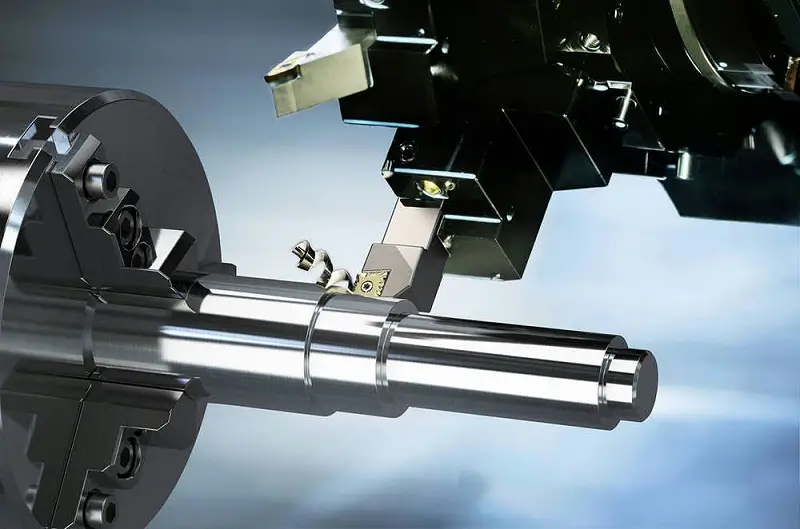
CNC Milling vs CNC Turning
One question I hear constantly from new engineers and designers is: “When do I choose milling over turning?” The distinction is fundamental, and getting it right can save significant time and money.
| Aspect | CNC Milling | CNC Turning |
|---|---|---|
| Primary Motion | Cutting tool rotates | Workpiece rotates |
| Typical Parts | Prismatic, flat, or complex 3D shapes (brackets, housings, molds) | Cylindrical or axis‑symmetric (shafts, rings, bushings) |
| Tool Movement | Multi-axis (X, Y, Z, plus rotational axes) | Primarily linear (X, Z axes) |
| Workpiece Holding | Clamped to table or vise | Held by a spinning chuck |
In short, if your part has flat surfaces, pockets, holes at odd angles, or complex contours, milling is almost always the right choice.
Anatomy of a CNC Milling Machine: Key Components
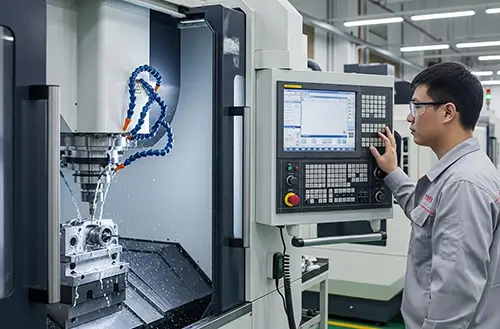
To truly understand what a milling center can do, you need to know its core components. Standing on the shop floor, here is what you are looking at:
- Machine Base & Column: The heavy cast iron structure that absorbs vibration and maintains rigidity. Weight is your friend here—it ensures precision.
- Spindle: The heart of the machine. It holds and rotates the cutting tool at high speeds (anywhere from 10,000 to 30,000 RPM or more). Spindle accuracy directly impacts surface finish.
- Tool Holder: The interface between the spindle and the cutting tool. Common types include CAT, BT, and HSK.
- Work Table (or Bed): Where the workpiece is clamped. On modern machines, this table can move in multiple directions.
- Linear Guideways & Ballscrews: These provide the smooth, precise motion for each axis. They convert rotational motion from servo motors into linear movement.
- Automatic Tool Changer (ATC): A magazine that holds multiple tools and swaps them into the spindle as needed. This is what allows unattended operation.
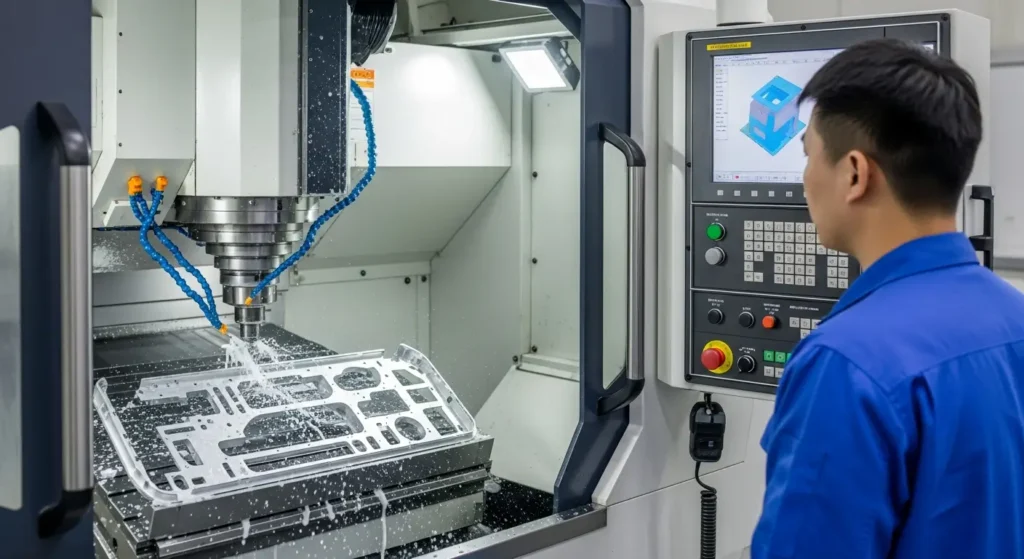
- Enclosure & Coolant System: Keeps chips contained and floods the cutting area with coolant to manage heat and lubricate the cut.
Types of CNC Milling Machines: From 3‑Axis to Multi‑Axis
Not all milling machines are created equal. The configuration determines the complexity of parts you can produce. Here is a breakdown of the most common types:
| Machine Type | Axes | Capabilities | Typical Application |
|---|---|---|---|
| 3‑Axis Mill | X, Y, Z (linear) | Basic machining of flat surfaces, pockets, and holes. | Brackets, plates, simple enclosures. |
| 4‑Axis Mill | X, Y, Z + A (rotary) | Adds the ability to rotate the workpiece, allowing machining on multiple faces in one setup. | Rotary parts, gear blanks, indexed features. |
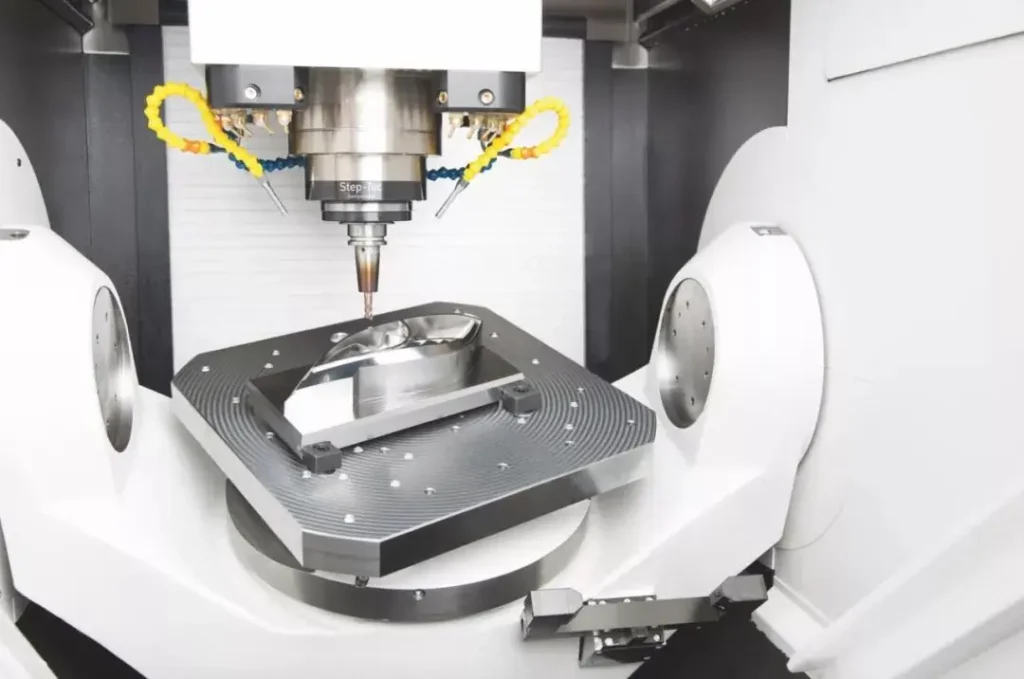
| 5‑Axis Mill | X, Y, Z + A, B (or C) | Full contouring capability. Tool or workpiece tilts to reach complex angles. | Aerospace impellers, medical implants, turbine blades. |
| Horizontal Mill | Spindle is horizontal | Excellent chip evacuation; rigid for heavy cuts. | Automotive engine blocks, large production runs. |
| Vertical Mill | Spindle is vertical | Most common; versatile and easy to fixture. | General prototyping, tool rooms, job shops. |
The jump from 3‑axis to 5‑axis is transformative. With 5‑axis, you can machine complex undercuts and organic shapes in a single setup, eliminating multiple fixture operations and dramatically improving accuracy.
Common CNC Milling Operations
A CNC mill is incredibly versatile. With the right tooling, it can perform a wide variety of operations. Here are the most common:
- Face Milling: Creating a flat, smooth surface on the top of a workpiece. This is often the first operation to establish a reference.
- Peripheral (Slab) Milling: Machining the outer edges of a part to create a vertical surface.
- End Milling: Using an end mill to create slots, pockets, and profiles. The tool cuts with both its end and its sides.
- Drilling & Tapping: Producing holes and internal threads. A mill can perform these operations with the same precision as a drill press.
- Boring: Enlarging an existing hole to a precise diameter with a single-point cutting tool.
- Reaming: Finishing a hole to an exact size with a smooth surface.
- Profile Milling: Following a curved path to create complex 2D or 3D shapes.
- Pocketing: Removing material inside a closed boundary to create a recess.
Modern CAM (Computer-Aided Manufacturing) software generates the toolpaths for these operations automatically, but understanding what each one does helps in designing parts that are easier—and cheaper—to machine.
Common Materials Used in CNC Milling
One of the strengths of CNC milling is its ability to handle almost any rigid material. The choice depends on the application, strength requirements, and budget:
- Aluminum (6061, 7075, 2024): The most common machining material. Lightweight, strong, and easy to cut. Ideal for aerospace, automotive, and consumer goods.
- Steel (1018, 4140, A36): Strong and cost-effective. Used for structural parts, machine components, and tooling.
- Stainless Steel (303, 304, 316): Corrosion-resistant but harder to machine. Common in medical, food processing, and marine applications.
- Titanium (Grade 2, Grade 5): Excellent strength-to-weight ratio and biocompatibility. Used in aerospace and medical implants. Requires rigid machines and careful speeds/feeds.
- Brass & Copper: Excellent machinability and electrical conductivity. Ideal for electrical connectors, fittings, and decorative parts.
- Plastics (Delrin/Acetal, Nylon, ABS, PEEK): Lightweight, corrosion-resistant, and often self-lubricating. Used for bearings, insulators, and prototypes.
- Composites (Carbon Fiber, G10): High strength-to-weight ratio but abrasive. Requires specialized tooling.
Advantages and Limitations of CNC Milling
Advantages:
- Versatility: Can produce an incredibly wide range of part geometries.
- Precision: Modern machines hold tolerances of ±0.0005″ (0.013 mm) routinely.
- Surface Finish: With proper speeds/feeds, milling produces excellent surface quality.
- Repeatability: CNC control ensures every part is identical, ideal for production.
- Material Flexibility: Cuts everything from soft plastics to hardened tool steels.
Limitations:
- Setup Complexity: Complex parts may require multiple setups or fixtures, increasing cost.
- Material Waste: Subtractive process generates chips; more waste than additive manufacturing.
- Size Constraints: Limited by the machine’s work envelope.
- Cost: High-end multi-axis machines represent a significant capital investment.
- Lead Time: Programming and fixturing take time before the first chip is cut.
Applications of CNC Milling in Industry
CNC milling is everywhere. Here are just a few examples of parts produced every day:
- Aerospace: Structural bulkheads, engine mounts, wing ribs, landing gear components.
- Automotive: Engine blocks, cylinder heads, suspension components, custom brackets.
- Medical: Surgical instruments, orthotic devices, implantable components, MRI housings.
- Electronics: Enclosures, heat sinks, connector housings, faceplates.
- Defense: Weapon receivers, sight mounts, ruggedized electronics enclosures.
- General Manufacturing: Gears, pulleys, fixtures, machine parts, prototypes.
- Mold & Die: Injection molds, blow molds, die casting dies.
CNC Milling vs. 3D Printing: When to Choose Which
With the rise of additive manufacturing, I’m often asked: “Should I mill this or print it?” Here is my rule of thumb:
| Factor | CNC Milling | 3D Printing |
|---|---|---|
| Material Properties | Uses production-grade materials with full strength. | Limited material options; parts may be anisotropic. |
| Tolerance | Tight (±0.001″ or better). | Looser; depends on printer calibration. |
| Surface Finish | Smooth as-machined. | Usually requires post-processing. |
| Geometry | Limited by tool access (can’t cut inside a closed space). | Almost unlimited complexity. |
| Quantity | Cost-effective for medium to high volumes. | Ideal for one-offs and low volumes. |
| Lead Time | Programming + machining time. | Often faster for simple prototypes. |
For functional, production-grade parts, milling is still the king. For rapid iteration and complex internal geometries, 3D printing wins.
Conclusion
CNC milling remains the most versatile and widely used machining process in modern manufacturing. From prototyping a single bracket to mass-producing critical aerospace components, it delivers the precision, repeatability, and material integrity that engineers demand.
Understanding the capabilities and limitations of milling—how many axes you need, what operations are possible, and how to design for manufacturability—can make the difference between a project that succeeds on time and on budget, and one that struggles with costly rework.
If you are designing a part with flat surfaces, precise holes, or complex 3D contours, chances are CNC milling is the right answer. And with today’s advanced multi‑axis machines, the only limit is your imagination.
At XINRICO, we specialize in precision CNC milling solutions tailored to your specific requirements. Whether you need a quick prototype or a full production run, our team of experienced engineers is ready to bring your designs to life. We offer competitive pricing, fast lead times, and rigorous quality control on every part.