If you’ve ever wondered how cylindrical metal parts—like shafts, bushings, or even the threaded rod in a vice—are made with such incredible accuracy, the answer is almost always CNC Turning. As a manufacturing engineer, I’ve spent countless hours watching these machines work, and I can tell you that understanding the fundamentals of turning is essential for anyone involved in design, production, or procurement.
In this guide, we’ll break down exactly what CNC turning is, how it differs from milling, the various machine configurations available, and why it remains the go‑to process for rotational parts.
How CNC Turning Works
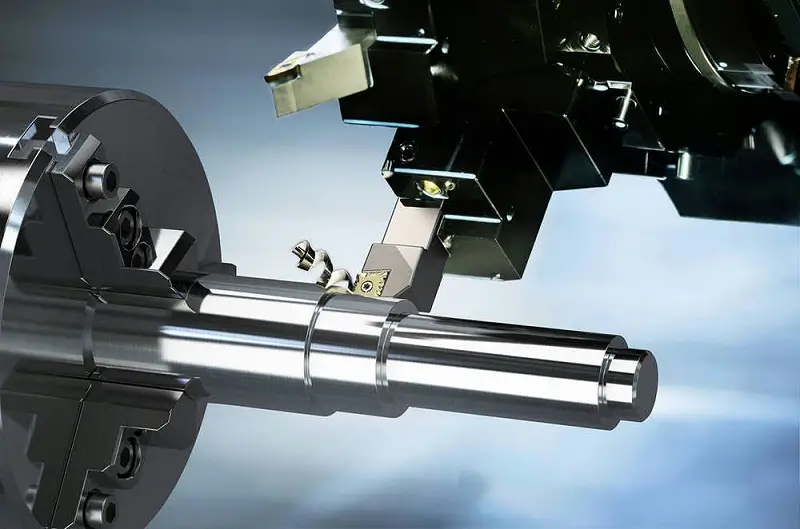
At its core, CNC turning is a subtractive manufacturing process where a cutting tool removes material from a rotating workpiece. The acronym CNC stands for Computer Numerical Control—meaning the entire operation is guided by a pre‑programmed set of instructions (G‑code).
Imagine a classic potter’s wheel: the clay spins, and the potter’s hands shape it. CNC turning works on the same principle, but with extreme precision and hardened metal. The workpiece is securely held by a chuck and rotates at high speed (the primary motion), while a stationary cutting tool moves linearly to carve away material. The result is a perfectly symmetrical part with diameters, tapers, and grooves exactly where they need to be.
CNC Turning vs. CNC Milling
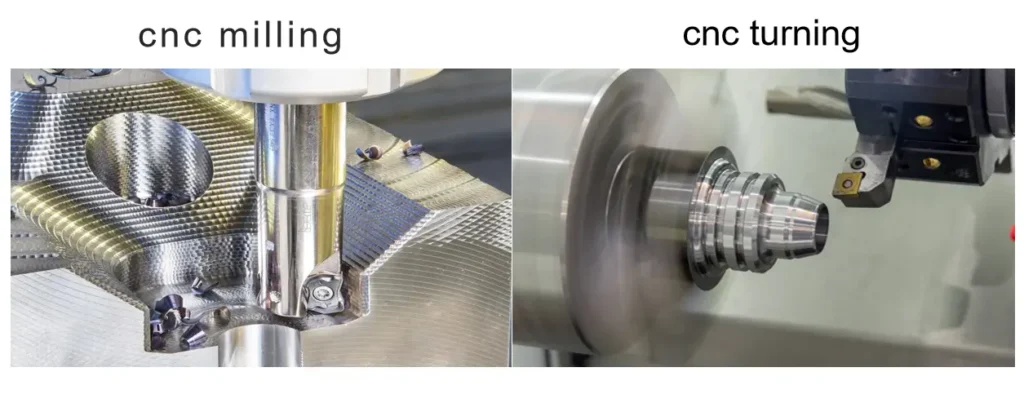
One of the most common questions I get from new designers is: “What’s the real difference between turning and milling?” It’s a fair question, because both machines remove material, but they do it in fundamentally opposite ways.
| Aspect | CNC Turning | CNC Milling |
|---|---|---|
| Primary Motion | Workpiece rotates | Cutting tool rotates |
| Typical Parts | Cylindrical or axis‑symmetric (shafts, rings) | Prismatic or flat (brackets, housings, slots) |
| Tool Movement | Tool moves linearly (X, Z axes) | Tool moves in multiple axes (X, Y, Z, often rotary) |
| Set‑ups | Often one set‑up for complete outside/inside features | May require multiple set‑ups for complex geometries |
In short, if your part looks like something that could be spun on a lathe, turning is usually the most efficient method.
Anatomy of a CNC Turning Center: Key Components
To appreciate what a turning center can do, it helps to know its main parts:
- Headstock & Spindle: Houses the main motor and spins the workpiece. The spindle’s accuracy directly affects part quality.
- Chuck: Grips the workpiece. It can be hydraulic, pneumatic, or manual, depending on the application.
- Tool Turret: Holds multiple cutting tools and indexes them into position automatically. Modern turrets can hold 12, 16, or even 20 tools.
- Tailstock: Supports the free end of long workpieces to prevent deflection during machining.
- Guideways & Ballscrews: Provide the linear motion for the tool (X‑axis for cross movement, Z‑axis for longitudinal movement).
These components work together to achieve tolerances down to a few microns—remarkable when you see it in person.
Types of CNC Turning Operations
A CNC turning center isn’t limited to simply reducing diameter. With the right tooling, you can perform a wide variety of operations in a single set‑up:
- OD Turning (Roughing & Finishing): Reducing the outer diameter to the required size.
- Facing: Creating a flat, reference surface on the end of the part.
- Boring: Enlarging or finishing an existing hole.
- Grooving & Cut‑Off: Cutting narrow channels or separating the finished part from the bar stock.
- Threading: Producing internal or external screw threads.
- Drilling & Tapping: Using live tools (rotating tools) to drill cross‑holes or axial holes.
When live tooling and additional axes are available, a turning center can even perform light milling operations—blurring the line between turning and milling.
CNC Turning Machine Configurations: From 2‑Axis to Multi‑Axis
Not all turning machines are created equal. The number of controlled axes determines the complexity of parts you can produce. Here’s a quick comparison:
| Configuration | Axes | Capabilities | Typical Application |
|---|---|---|---|
| 2‑Axis Lathe | X, Z | Basic turning, facing, boring, threading. | Simple shafts, bushings, nuts. |
| Turning Center with Y‑Axis | X, Z, Y | Adds off‑center milling, drilling, slotting. | Parts with keyways, flats, or cross holes. |
| Multi‑Axis Turn‑Mill | X, Y, Z, C (and B) | Full contouring, milling, drilling, tapping in one set‑up. | Complex components like turbocharger wheels, medical implants. |
The C‑axis allows the spindle to position the workpiece precisely for milling operations, while a B‑axis lets the tool head tilt—enabling true 5‑axis machining on a turned part.
Common Materials Used in CNC Turning
Turning works with almost any machinable material. The choice depends on the application:
- Aluminum (6061, 7075): Lightweight, excellent machinability, used in aerospace and automotive.
- Steel (1018, 4140, 12L14): Strong, cost‑effective, ideal for shafts and structural parts.
- Stainless Steel (303, 304, 316): Corrosion resistant, common in medical and food equipment.
- Brass & Copper: Good conductivity, easy to machine, used for electrical fittings and valves.
- Titanium (Grade 5): High strength‑to‑weight ratio, but challenging to cut—requires rigid setups.
- Engineering Plastics (Delrin, Nylon, PEEK): Lightweight, chemical resistant, often for bearings or insulators.
Advantages and Limitations of CNC Turning
Advantages:
- High efficiency: Material removal rates are very high compared to milling.
- Excellent surface finish: The continuous cutting action yields smooth surfaces.
- Consistency: CNC control ensures every part is identical, ideal for production runs.
- Low set‑up time: For simple parts, set‑up can be just minutes.
Limitations:
- Part geometry: Turning is best for axis‑symmetric parts. Complex undercuts or non‑rotational features require additional operations or multi‑axis machines.
- Tool accessibility: Internal features deep inside a bore can be difficult to reach.
- Initial cost: High‑end turning centers with live tooling represent a significant investment.
Applications of CNC Turning in Industry
You encounter turned parts every day without realizing it. Here are just a few examples:
- Automotive: Pistons, drive shafts, brake rotors, and threaded fasteners.
- Aerospace: Engine mounts, hydraulic fittings, landing gear components.
- Medical: Bone screws, surgical instrument handles, implantable stems.
- Oil & Gas: Valve bodies, connectors, drill bit components.
- General Manufacturing: Pulleys, rollers, bushings, and custom prototypes.
Conclusion
CNC turning remains one of the most reliable and cost‑effective machining processes for cylindrical components. Whether you need a single prototype or a million production parts, understanding how turning works—and what modern turning centers are capable of—will help you make smarter design and sourcing decisions.
If you’re designing a part that looks like it could spin, chances are CNC turning is the right choice. And with today’s multi‑axis machines, you can often complete the part in one operation, saving time and money while achieving outstanding precision.