You requested a quote for a 7075-T6 aerospace bracket, and got three responses: $127, $98, and $210. The cheapest one has a 2-week lead time, the most expensive promises 3-day turnaround, and none of them break down what you’re actually paying for. If you’ve ever stared at a CNC machining quote wondering where the hidden fees are, or if you’re paying for parts that meet your spec, this guide is for you.
We’ll break down every standard line item, call out common hidden costs for US and EU buyers, and give you a real example of how to spot a bad quote before you sign off. No marketing fluff, just facts you can use on your next project.
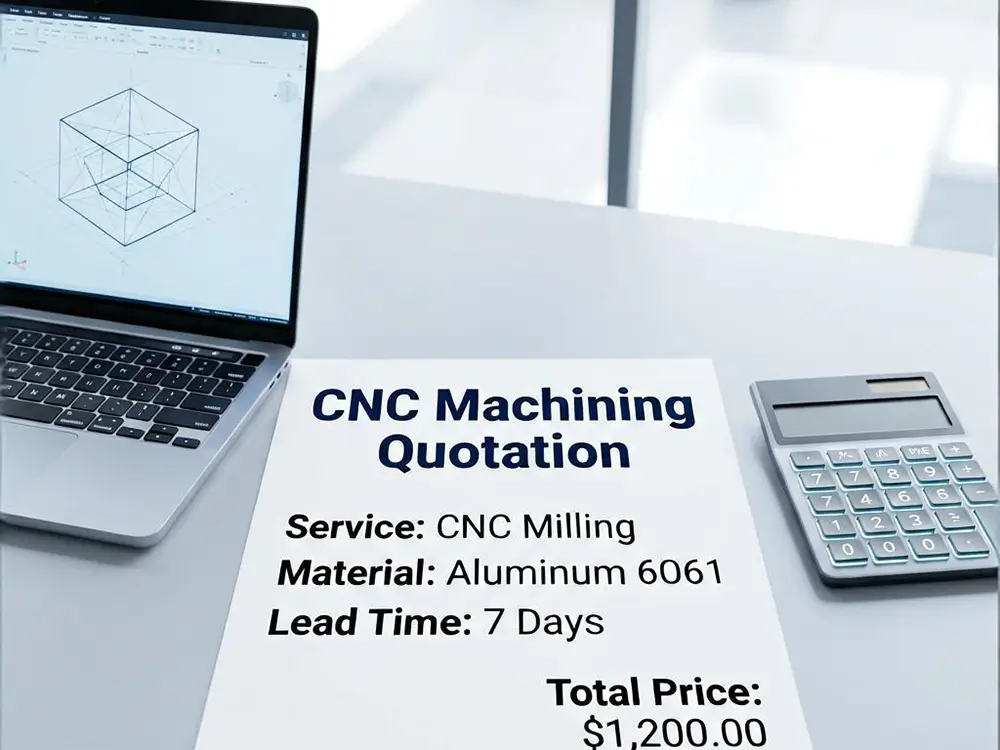
Standard CNC Quote Line Items, Explained
Every transparent CNC quote breaks down costs into five core buckets. If a shop refuses to itemize these, walk away.
1. Material Costs
This covers the raw stock (aluminum, stainless steel, titanium, etc.) plus a 10-20% markup if the shop sources it for you, and includes scrap allowance for the leftover material cut from your part blank.
- US markets quote per pound; EU markets quote per kilogram. Exotic alloys (Inconel, titanium) cost 3-5x more per kg/lb than 6061 aluminum.
- Red flag: Shops that bill scrap separately after machining, with no prior disclosure.
- Pro tip: If you supply your own certified material (called customer-supplied material, or CSM), you can eliminate this markup entirely, but you’re responsible for ensuring the material meets your spec.
2. Machining Labor
This is the cost of running your part on the CNC machine, calculated based on machine hourly rate, cycle time, and part complexity.
- 3-axis mills cost ~$80–120/hr in the US, ~€70–100/hr in the EU. 5-axis mills cost 2–3x more per hour.
- Tight tolerances (±0.01mm vs ±0.1mm) add 20–40% to labor costs, as slower feeds and more frequent tool changes are required to hold spec.
- Red flag: Quotes that lump material and machining into a single “part cost” line with no breakdown.
3. Setup and Tooling Costs
Setup covers one-time, pre-production work: custom fixturing to clamp your part blank to the machine bed, CAM programming to convert your CAD to machine code, and first-article calibration. Tooling costs cover wear and tear on end mills, inserts, and other cutting tools.
- For 1-off prototypes, setup makes up 30–50% of the total quote. For runs of 500+ parts, setup is amortized to <5% per part.
- Red flag: Shops that hide setup fees in “overhead” or “shop minimum” charges with no explanation.
4. Post-Processing and Finishing
This is where 70% of hidden fees live. Common add-ons that are often omitted from initial lowball quotes:
- Deburring, passivation, anodizing, heat treatment, or bead blasting
- Inspection: First Article Inspection (FAI, required for aerospace/medical parts), CMM measurement, or material certification
- Certificates of Conformance (CoC) for regulated industries (FDA for medical, CE for EU industrial parts)
- Red flag: Quotes that don’t list required finishing or inspection if you included those requirements in your request for quote (RFQ).
5. Shipping, Tax, and Compliance
- US quotes almost always exclude state sales tax (0–10% depending on location) unless stated. EU quotes often exclude VAT (19–27% depending on country) unless marked DDP (Delivered Duty Paid).
- ITAR compliance for US defense parts, or REACH/RoHS compliance for EU consumer goods, often adds 5–10% to the total quote if required.
- Red flag: Quotes that don’t specify incoterms (EXW, FOB, DDP) – you could end up paying thousands in unexpected import duties.
Real-World Analogy: It’s Like Hiring a Custom Furniture Builder
Think of a CNC quote like a bid for a custom solid oak dining table. The lowest bid isn’t the best value if it skips sanding, uses particle board instead of oak, and doesn’t include delivery to your home. You’ll end up paying more later to fix peeling finish, replace warped wood, or haul the table yourself.
CNC quotes work the same way. A 30% cheaper quote almost always skips required finishing, cuts corners on inspection, or omits hidden fees you’ll be billed for later.
Side-by-Side Quote Example
Let’s look at two quotes for 25 316L stainless steel surgical clamp parts, ±0.02mm tolerance, passivated, with CMM inspection and CoC for EU medical use:
| Line Item | Transparent Quote (€2,200 total) | Lowball Quote (€1,450 total) |
|---|---|---|
| Material (scrap included) | €420 | Included in “machining” line |
| Machining labor (5-axis setup + 25 part cycles) | €1,100 | Included in “machining” line |
| Post-processing (passivation, CMM inspection, CoC) | €480 | Omitted entirely |
| Shipping + 21% German VAT (DDP) | €200 | €150 (EXW, buyer pays import duties) |
The lowball quote looks 34% cheaper upfront, but it’s missing €480 in required finishing and inspection, and you’ll pay an extra ~€300 in import duties. The final cost is €1,750, only 20% cheaper than the transparent quote, and you’ll wait 2 extra weeks for the missing finishing work.
Red Flags to Watch For
- Vague line items labeled “miscellaneous fees” or “shop overhead”
- No breakdown of post-processing or inspection if you requested it in your RFQ
- Lead times 30% faster than industry average for your part complexity (almost always means they’re skipping finishing or inspection)
- No mention of tolerance compliance or material certification
- No specified incoterms for cross-border US/EU orders
FAQ
Are CNC quotes fixed price, or will I get billed extra later?
Reputable shops provide fixed-price quotes for the full scope of work you specify. Extra charges only apply if you request unplanned design changes mid-project, or if the shop finds a critical error in your CAD that requires a revised quote (they will flag this and get approval before starting work). Always confirm the quote scope includes all required finishes, inspections, and tolerances before approving.
Why do low-volume prototype quotes have such high per-part costs?
Low-volume quotes include one-time setup costs (fixturing, CAM programming, first-article inspection) that are amortized across the small lot size. For a 1-off part, setup can make up 40–60% of the total cost. For runs of 500+ parts, setup drops to <5% per part.
Does a CNC quote include Design for Manufacturing (DFM) feedback?
Most shops include basic DFM feedback (e.g., “this wall is too thin for the material you specified”) for free with your quote. Detailed DFM analysis for complex, high-precision parts (aerospace, medical) may be a paid add-on, usually $100–$300 depending on part complexity.
What’s the difference between a per-part quote and a volume lot quote?
A per-part quote is for one-off or very low-volume runs (1–10 parts) with full setup costs included. A volume lot quote applies to runs of 50+ parts, where setup costs are spread across the full lot, reducing per-part cost by 30–70% depending on quantity.
Can I negotiate line items on a CNC quote?
You can negotiate non-labor line items for repeat orders: most shops will discount setup fees for returning customers, or reduce material markup if you supply your own certified stock. Machining labor rates are rarely negotiable for low-volume runs, as they’re tied to machine hourly costs and technician wages.
Call to Action
Ready to get a transparent, no-hidden-fee quote for your next CNC part? Upload your CAD file (STEP, IGES, SolidWorks, or Fusion 360 formats accepted) to our instant quoting portal, and receive a full line-item breakdown, lead time estimate, and optional free DFM feedback within 4 business hours. No fine print, no surprises.
[Upload Your CAD for a Free Quote Now]
Word count: 942