When you’re selecting a material for a CNC‑machined component, the decision often boils down to a trade‑off between strength, machinability, corrosion resistance, and cost. Two of the most common aluminum alloys in the workshop are 6061‑T6 and 7075‑T6. Both are widely stocked, readily machinable, and serve as go‑to choices for everything from brackets to aerospace fittings. Below is a side‑by‑side look at how they compare, followed by a frank discussion of when each shines (or falls short), cost considerations, a quick FAQ, and a call‑to‑action to help you move forward with confidence.
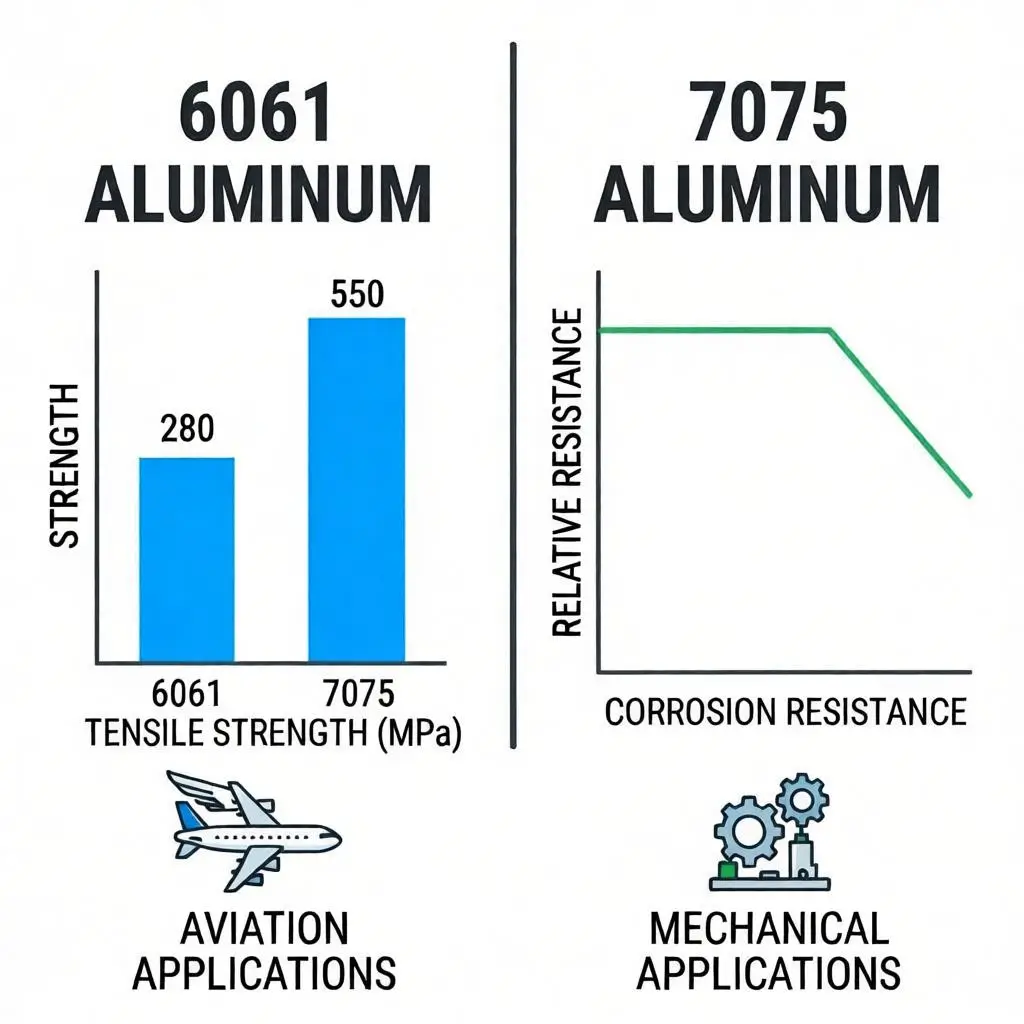
Quick‑Look Comparison Table
| Property | 6061‑T6 | 7075‑T6 |
|---|---|---|
| Primary alloying elements | Mg (0.8‑1.2 %), Si (0.4‑0.8 %), Cu (0.15‑0.4 %) | Zn (5.1‑6.1 %), Mg (2.1‑2.9 %), Cu (1.2‑2.0 %), Cr (0.18‑0.28 %) |
| Typical tensile strength | 310 MPa (45 ksi) | 570 MPa (83 ksi) |
| Yield strength | 276 MPa (40 ksi) | 503 MPa (73 ksi) |
| Elongation at break | 12‑17 % | 5‑11 % |
| Hardness (Brinell) | 95 HB | 150 HB |
| Machinability rating | Excellent (≈ 90 % of free‑cutting brass) | Good (≈ 70 % of free‑cutting brass) |
| Corrosion resistance | Very good (natural oxide layer, suitable for marine) | Moderate (more prone to stress‑corrosion cracking; often requires coating or anodizing) |
| Weldability | Good (can be TIG/MIG welded with proper filler) | Poor (prone to cracking; usually avoided for welded assemblies) |
| Typical applications | Structural frames, bicycle parts, automotive housings, general‑purpose fixtures | High‑stress aerospace fittings, missile components, high‑performance automotive, defense |
| Relative material cost (USD/kg) | $2.5‑$3.0 | $4.0‑$5.0 |
| Typical CNC machining cost impact | Lower tool wear, faster cycles, less coolant usage | Higher tool wear, slower feeds, more frequent tool changes |
Values are representative of standard tempers (T6) and can vary slightly with heat treatment and supplier.
When 6061‑T6 Is the Better Choice
- Machinability & Throughput
If your shop runs high‑volume production or you need tight tolerances with minimal tool changes, 6061’s excellent machinability translates directly into lower cycle times and reduced tooling expense. The alloy’s lower hardness means carbide end mills last longer, and you can push higher spindle speeds without sacrificing surface finish. - Corrosion‑Critical Environments
Marine hardware, outdoor enclosures, or any part exposed to moisture and salts benefit from 6061’s naturally protective oxide film. While you can anodize 7075, the base alloy is more susceptible to stress‑corrosion cracking, especially under tensile loads in chloride‑rich environments. - Welding or Post‑Machining Fabrication
Projects that require welding, brazing, or extensive secondary operations (e.g., adding threaded inserts after machining) are far more forgiving with 6061. Its weldability reduces the need for specialized filler metals or post‑weld heat treatment. - Budget Sensitivity
At roughly 30‑40 % lower material cost, 6061 can be the deciding factor when you’re producing large batches or when the part’s strength requirements are comfortably met by its 310 MPa tensile rating.
When 7075‑T6 Takes the Lead
- Maximum Strength‑to‑Weight Ratio
With a tensile strength nearing 570 MPa, 7075 offers almost double the load‑bearing capacity of 6061 for a comparable weight. In aerospace, motorsport, or any application where every gram counts and the part sees high cyclic loads, 7075’s superiority is hard to ignore. - High‑Stress, Low‑Deflection Parts
If the component will experience significant bending moments, impact loads, or needs to maintain stiffness under load (e.g., landing gear brackets, high‑performance drive shafts), the higher modulus and yield strength of 7075 reduce deflection and improve fatigue life. - Limited Machinability Can Be Managed
Although 7075 is tougher on tools, modern carbide grades, high‑pressure coolant, and optimized tool paths can mitigate wear. For low‑to‑medium volume runs where the performance gain justifies the extra tooling cost, many shops find the trade‑off acceptable. - When Weight Savings Translate to System‑Level Benefits
In some designs, using 7075 allows you to downsize other components (e.g., thinner walls, smaller fasteners) because the base material is stronger. The net effect can reduce overall part count, assembly time, and even system weight—benefits that may outweigh the higher per‑kilogram material price.
Cost Implications: Beyond the Price Tag
| Cost Factor | 6061‑T6 | 7075‑T6 |
|---|---|---|
| Raw material | $2.5‑$3.0/kg | $4.0‑$5.0/kg |
| Tool wear | Low → fewer tool changes, lower tooling inventory | Moderate‑high → more frequent inserts, higher tooling cost |
| Machining time | Faster (higher feed rates, higher spindle speeds) | Slower (more conservative parameters) |
| Secondary processing | Easier welding, less need for protective coatings | Often requires anodizing or plating to mitigate corrosion |
| Scrap/rework | Lower due to forgiving nature | Higher if cracks develop during machining or welding |
For a typical medium‑complexity part (≈ 150 mm³ volume), the total cost per piece can be estimated as:
- 6061: material ≈ $0.40, machining ≈ $0.30, tooling amortization ≈ $0.05 → ≈ $0.75
- 7075: material ≈ $0.70, machining ≈ $0.45, tooling amortization ≈ $0.10 → ≈ $1.25
These numbers are illustrative; actual shop rates will vary, but the ratio usually holds: 7075 adds roughly 60‑70 % more to the part cost, driven mainly by material and extra tooling wear.
FAQ
Q1: Can I heat‑treat 6061 to reach 7075 strength levels?
A: No. 6061’s strength ceiling is set by its Mg‑Si precipitation hardening; even with a T6 temper it tops out around 310 MPa. To get 7075‑level strength you must start with the 7075 alloy itself.
Q2: Is 7075 always worse for corrosion?
A: Not inherently. In dry, indoor environments the difference is minor. However, in marine or high‑humidity settings, 7075 is more prone to stress‑corrosion cracking unless protected (e.g., anodizing, alodine, or paint).
Q3: Does the higher hardness of 7075 affect surface finish?
A: It can. With the same tool geometry and parameters, 7075 may produce a slightly rougher finish due to increased tool deflection. Using sharper inserts with a higher rake angle and adequate coolant usually mitigate this.
Q4: Are there any hidden costs when switching from 6061 to 7075?
A: Yes—expect to recalibrate feeds/speeds, possibly invest in more robust tool holders, and budget for additional inspection (e.g., dye‑penetrant) to catch micro‑cracks that can develop during machining.
Q5: Which alloy is easier to recycle?
A: Both are highly recyclable, but 6061’s lower alloying content makes it marginally easier to re‑melt without segregation concerns. In a closed‑loop shop, the recycling cost difference is negligible.
Bottom Line & Call‑to‑Action
Choosing between 6061‑T6 and 7075‑T6 isn’t about declaring a universal winner; it’s about matching the alloy’s strengths to the specific demands of your part—strength, weight, environment, manufacturability, and budget. Run a quick trade‑off study: calculate the required safety factor, estimate machining time with your current tooling, and compare the total cost per piece. If the strength margin of 6061 comfortably meets your load case and you value speed and lower tooling spend, go with 6061. If the design is pushing the limits of weight‑critical performance and you can absorb the extra machining overhead, 7075 will pay off in structural efficiency.
Ready to see how each material behaves on your actual part? Upload your CAD model to our instant quoting platform, select either 6061 or 7075, and receive a detailed machinability report, cost breakdown, and lead‑time estimate—all in under five minutes. [Get Your Quote Now] and make the next material decision with confidence.